Wednesday, 18 September 2013

Different strokes

There are two ways of writing travel. One is the destination guide. It's written to be useful to the average person. It has all the noteworthy monuments that everybody will be interested in.

I found it instructive to compare the Rough Guide with guides handed out by Indian tourist authorities in Madhya Pradesh and Uttar Pradesh. There's a distinct difference in their average reader.
  • The average Rough Guide reader wants to see history, unspoilt nature, the picturesque.
  • The average Indian tourist wants to see major monuments, sunrises and sunsets from the appropriate 'Sunset Point', and visit lots of temples with particularly interesting stories.
 So for Allahabad, the Rough Guide mentions the Muslim tombs of Khusro Bagh (a delightful place to visit, with its horse-shoe decorated doorway, charmingly painted mausoleums, and tall palm trees, where young students relax on the lawns and toddlers run about till they exhaust themselves, like small clockwork mechanisms), the Sangam, and the colonial heritage, while the UP Tourism guide is full of temples and ashrams. Even so, you can see that both guides are written for l'homme moyen sensuel, the average tourist, with no special interests and relatively little patience. Industrial heritage gets a very short shrift, for instance.

There's another kind of travel writing and that's driven by special interests, by particularity, by the specific. For instance, simply because I'm a collector of fountain pens, I ended up seeing India through different eyes; a land where vintage fountain pens are still being made. I ended up visiting parts of Indian cities I would never have bothered with as a tourist, like the stationery shops of Nai Sarak in Delhi. While Chandni Chowk is full of tourists being pestered to buy pashminas and silver, in Nai Sarak I wandered round the shops looking for leather bound accounting books and Indian pens, and finding all kinds of ironmongery, university textbooks, confectionery - and a few ancient Mughal doorways and small, incense-laden shrines tucked away in back alleys. (I wrote about it on Fountain Pen Network.) I even ended up quoted in an article in Calcutta's Good News Tab when I met one of their journalists in the Calcutta Pen Hospital.

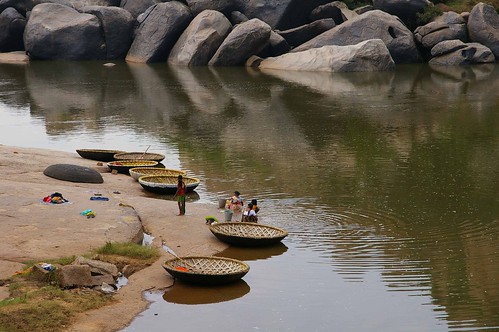
My father isn't a travel writer. He's a historian who specialises in maritime and industrial history and the history of East Anglia. For the last couple of years he's been working on the two volumes of Maritime Norfolk - Suffolk has had to wait... So whenever I travel, I keep an eye out for boat builders and repairs; coracles on the river at Hampi, dhows being built in Mandvi (maybe the last wooden ships to be built there), a man repairing a small river craft on the Varanasi ghats. I'm fascinated by the tall factory chimneys of the industrial region on the borders of Bihar and West Bengal, by rural brickworks at Sonagiri. And I've found that because I'm interested, people respond to me - from the brickmakers who waved at me and posed on their trailer for a photo, to the brassworkers of Chamba who let me sit in their shop for an hour, brought me tea, and showed me accreditations, prizes, and photos of their work for major temples - while managing, in between times, to get on with their work, beating vase necks on mandrels till they fitted the bowls that had already been made.

(I wonder  with local history; is it history or is it travel writing? To some extent, when it focuses on the particularities of a place, what makes that place different, what distinguishes it, then it's travel writing, as well as history. And travel writing, while it's about the experience of one traveller, is also about that hinterland of history and myth that is bound up in making a place what it is.)

Then there's my decision to make kitchenware into my preferred souvenir. I've bought wooden forks and spoons in Sikkim, spatulas in the markets of Istanbul, a lovely gsaa in Rabat and a pestle and mortar in Meknes. No doubt if I visit Japan I'll come back with all kinds of sushi making gizmos and a set of lacquered bowls. (In Korea, monastic meals are even more structured than the tea ceremony; four bowls are laid out, filled, eaten from, and put away in their order, a fact I found out at the Korean vihara in Sarnath: its' called barugongyang.)

So that's not just two kinds of travel writing. It's two kinds of travelling. One prejudges what's going to be interesting; this monument, that landscape. The other says: let's set out and find interesting things. One looks for "typical India", the other for interesting India. One says: I'm an average person, let's go travelling. The other says: I have all kinds of odd interests and bits of knowledge, let's go and use those to get to know people and places. I find the first kind of travel is okay; but the second makes travelling marvellous.


Brickworks

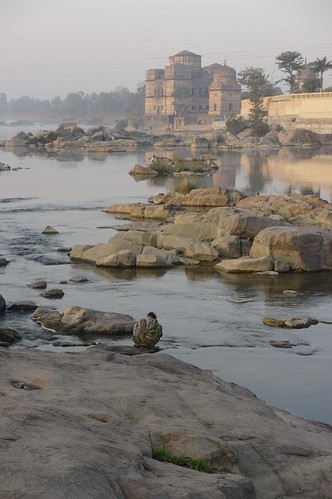
Here's a brickworks, old style, near Sonagiri, MP, India. Bricks are not things that are made in a huge industrial brickyard and exported on the back of lorries or by train for hundreds of miles; they are made in the local brickyard and come chugging to you along the country roads on a tractor trailer.
Brickworks by Andrea Kirkby
This is the way bricks were made in England, once upon a time. My father is a local and industrial historian; I remember the excitement of looking for old lime kilns on family holidays, sometimes hidden under brambles and briars, sometimes at the bottom of a well tended country garden.

So it was fascinating for me to see little local brickyards dotted all over the countryside. In the UK industry tends to be corralled and neutered - it's hidden out of the way on 'industrial estates' or whole swathes of townscape are given up to it, and we try to distance it from the places where we live. In India, on the other hand, manufacturing is still something that is done openly, that you see on the street and in the fields.

In some ways that's good. In other ways, not so good - pollution can be a problem, and some areas become degraded when there's no planning, no control over land use, and no oversight of public areas. But on this bright day on the way to Sonagiri, I got a smile and a wave from the brickward workers, and watched the smoke of the kilns that were being fired drift up into a still sky, and wondered, as I walked, whether the decline of British manufacturing started when we decided that it was dirty and noisy and uncivilised, and we ought to hide it away.


Brickworks, a photo by Andrea Kirkby on Flickr.

Tuesday, 10 September 2013

My Indian Top Ten

As a journalist I often get asked to write 'top ten tips' or 'ten ways to' or 'ten reasons why'... never six, or eight, or nine, but ten. It's got a certain feeling of completion to it, I suppose. (If we had more fingers, it might be a bigger number...) And it's a common format. I quite often see top ten destination pieces.

What editors want, of course, is a Pareto formula 80/20 - 80 percent the regular stuff, and 20 percent offbeat. So for instance if I were to write top ten tips for selling your house, eight of those tips would be basics (touch up the paintwork, tidy away the trash, make sure your garden has 'kerb appeal'), and two might be funny (make sure you don't oversleep so the potential purchasers find you in bed!) or niche (bachelors, consider putting throws over the black leather suite) or detailed (clean out the fridge).

So if I were writing an Indian top ten article for a newspaper, it would have to feature:
  1. the Taj Mahal
  2. Goa
  3. Jaipur
  4. Delhi
  5. Keralan houseboats
  6. Varanasi
  7. Udaipur
  8. Mumbai
and then I'd be allowed to mention a couple of places I really liked. For a backpacker publication the first eight might include Hampi and Rishikesh and exclude Mumbai, and a culture-led list might include a couple more World Heritage sites (Ajanta, Ellora perhaps) and exclude Udaipur or Delhi, but I don't think the lists would be very different.

Well this list is going to be different. It's purely and simply the places I have loved the most.
  1. Hampi
  2. Mandu
  3. Orchha
  4. Bundi
  5. Gujarat in general.- Champaner, Palitana, Girnar
  6. Chanderi
  7. The Brahmaputra
  8. Trichy
  9. Parasnath
  10. The Indus Valley in Ladakh
Hampi, the former capital of Vijayanagar, is a village in a city - quite literally since part of the village has been built inside the ruins of Vijayanagar's bazaar.

It's pretty well known and pretty touristed, with a lot of guesthouses and tourist-orientated shops. But it's still small town India - tiny schoolgirls with their hair in plaits and gingham shirts tucked into grey pleated skirts walk up the road with serious faces every morning, the temple elephant goes for its bath, pilgrims sleep in the temple courtyard. I was invited to a wedding at one temple up in the hills; I talked philosophy and religion with the priest at one Shiva shrine, where cool air blew through cracks in the mountain into the cave; I chatted to a woman who'd come back to find the place she'd stayed twenty years before, and had found it. And I walked; from temple to temple, palace to palace, in the fine landscape of tumbled rocks and conical hills on both banks of the roaring Tungubhadra, in a world whose colours were so delicate and luminous it seemed to have been painted in watercolour.


Mandu, like Hampi, is a once-capital become a village; but it's not a big tourist stop; Indian tourists come to see the palaces and temples, but it's only the pilgrims who stay. I met some at the Rama temple, more at the tiny Neelkanth temple (one a raja's summerhouse) that hangs on the edge of a precipice overlooking the plains of Madhya Pradesh. I went to the evening service with some of them, who were half way through the circumambulation of the river Narmada - up one bank and down the other - carrying nothing but their puja materials in a bag; a mirror, a sacred image, incense, an oil lamp. I left early; as I sat on the veranda of my guest room at the temple, departing pilgrims waved and wished me good evening, a ceremonious kindness.

Mandu is relatively flat. But on every side of the plateau, massive cliffs fall away, and narrow gorges claw their way into the massif. Below, bright green fields chequer and stripe the plain. There are monuments of great ambition - the mosque, the tower of victory, the royal palace with its subterranean chambers where funnelled breezes and channelled water cool the air - and there are small domed tombs and miniature mosques scattered in the fields, past villages where children yell and the grated ice man comes once a day on his tricycle.

Back at the temple after my day's cycling, I talked to a young Hindu pilgrim monk. I'd thought at first he was a temple pujari, but no, he was only staying for a week or two; he dreamed of teaching meditation coupled with the Thai boxing he used to practise when he was in the world.

"Once I was in the jungle," he told me. "I went with a friend, but my friend said this is too hard, I'm going, you can die here if you want to. And I stayed in the jungle. One day I saw a leopard, very close, just like you are now, and I said: Hari Ram! if I die, I die. And the leopard looked at me and walked away. If your faith is strong, you can do anything."


Orchha is a place where I did the wrong thing, and it worked. I let a rickshaw driver take me to a guesthouse. Temple View Guesthouse is now 'family' as far as I'm concerned. I settled in. One American tourist told me she'd 'done' Orchha; it took her three days to feel bored and constricted. After a month, I loved the place. It's another former capital, like Mandu and Hampi, with palaces, royal cenotaphs, and fine temples; but it's also a buzzing small town, when the Ramraja Temple has a festival, and people come from all over Bundelkhand; or during the marriage season, when the streets are alive with processions and sound systems, stallions wait patiently for the bridegrooms down by the river, and newlyweds with their friends visit the little garden shrine behind the Phool Mahal.

Do Orchha as a day trip and you'll be the target of hustle. Stay there a week and people get to know you; the little deaf guy and his friend from the Chaterbuj temple, Ram Babu the fruit man and 'magic fingers' (karom champion and magician both), even the children of the village and the pujari of the Hanuman temple. Orchha is my home in India. What more can I say?

Bundi is another small town. Yes, small town India is so much nicer than city India. I accept the attractions of Mumbai, for instance (including some amazing shops for vintage Indian fountain pens, as well as colonial architecture and the tremendous cave temples at Elephanta), but the smaller towns are where my heart is. Bundi, in Rajasthan, has everything you want: palaces piled high on the sides of a hill, all pavilions and pinnacles, with the most lovely mural paintings I've seen, in which Krishna dances with the cowgirls, and Persian fairies oversee a huge military operation on the walls below; a massive fort above the town, where troops of wild monkeys roam; a bustling market, fine stepwells, and a calm lake that gleams red in the sunset. (I wish I'd stayed longer there and not gone on to Udaipur, a parody made for tourists.)


I'm going to be broad-brush with my next member of the top ten and nominate an entire state, Gujarat. Foreign tourists just don't go there. Travel is sometimes hard - there are reliable buses, but they're hard to find out about, no one has a timetable; there are dharamshalas and small hotels, but sometimes every hotel in town seems to be full, or you end up in a workers' hotel with shared showers and toilets a long way down a gloomy corridor. But look where you end up!
The lovely town of Mandvi, where you may still see wooden dhows being built, though that industry is dying out, and where the sandy beach runs 8 kilometres out of town towards the distant domes of a royal palace; Champaner, a Hindu holy mountain sheltering a former Muslim capital where mosques and even monumental pigeon-houses dot the countryside; Palitana, a temple city where only the gods stay overnight; the high peak of Mount Girnar, where steps lead up to Jain and Hindu temples, through the morning mists to the raw sunlight; Dwarka, where Krishna devotees kidnapped me to dance in the streets with them, and fed me till I nearly burst. Even Ahmedabad has its delights: the marvellous Calico Museum with its fine textiles and bronzes, by far the best museum I've visited in India; fine mosques where jali screens give dappled light, ancient pols with old wooden houses and fine gateways, and some of the best drinks and juice places in India (because, of course, Gujarat is a dry state).


Not far from Orchha  is Chanderi. Yet another small town, and one that didn't even make it into the edition of the Rough Guide I was using. Good. That keeps the tourists away. So does the fact that there's no guesthouse there; only a 600 rupee a night hotel. And only two restaurants, both hole-in-the-wall cafes where all the other customers were locals.

Perhaps my love of Chanderi stemmed initially from the fact that I had the luck to met Kalley Bhai, a local guide who showed me round the town after dinner and a cup of tea, for free. We wandered through the Bazar - one of the most famed bazars of the sixteenth century, though now it's a small town market frequented by cows, sleepy-eyed cats and local children - and he showed me tiny but exquisite havelis, friends who made confectionery (little hard sugar dragees, or squishy cakes), stalls selling Chanderi weaving. The weaving here is lovely, a cotton-silk mix; you hear looms click and thud in some of the old palaces. There are mosques and minarets, fine arches, extensive lakes; there's a giant Jain tirthankar carved into a cliff-face, a fort marooned above the city, tiny hills inviting you to climb them all around the town. There's one of the finest works of architecture I've seen in India, four storeys of what was a seven storey palace, where, if you dare (and I dared, though my heart was bursting through my ribs with fear), you can stand on a narrow remnant of vault and look down into the central light well.

I was invited to take tea with a young girl's family after I admired the carved door of her haveli. I spent time chatting with the confectioners. I climbed up to the fort, and wandered round the lakes, and my rickshaw driver let me sit in his rickshaw for half an hour and brought me tea while we waited for the bus, and charged nothing extra for the service. That's the kind of place Chanderi is.

Assam, like Gujarat, doesn't get as many tourists as other states, and I didn't have enough time to see it properly, just a few days in Guwahati and around. (For some reason, as soon as I arrived in Guwahati everyone assumed I wanted to get out of it - "Shillong, Shillong," the bus-touts chorused. But I stayed.) The Brahmaputra, for me, is one of India's genuine highlights - nearly two kilometres wide, with temple-crowned islands scattered across its braided channel, and tiny square-sailed boats carving its grey waters. Assamese temples are unlike those anywhere else in India, with open, wooden mandapas in front of gloomy shrines with huge stone pillars that crowd in, rising high above; inside, the darkness swims, heavy with incense.In one, the nine planets have their own small hearth-altars, with lamps and fires shining in the dark. In others, steps in the sanctuary lead down to a slash in the rock where a spring or stream flows, symbol of the dark goddess. Majuli, upstream, is a marshy, massive island full of small wooden shrines; or further downstream there's Hajo, a delightful town that surprised us with its hospitality and with its looming temple on the hill above a tank where huge fish come to be fed, and turtles lurk in the green water.

Tamil Nadu is the temple state, and I love Trichy for its combination of fine temples and a buzzing modern city. The Rock Fort amazingly combines a hilltop temple with views across the wide Carvery river and the plain with cave temples dug into the rock; in one mandapa I found a man sitting on a mat, chopping vegetables - the temple provides a charitable lunch for the poor. Across the river lies the Srirangam Temple, which holds an entire town within its multiple, concentric walls; and the Jambukeshwar temple, a little further out, has a huge tank full of water hyacinth, soaring gopuras, dim corridors, and gardens full of tall trees. But from the Rock Fort it's just a few minutes' walk to the shopping malls full of consumer electronics, or the grocery market where red-skinned onions roll across the pavement and buyers thrust their hands into sacks of rice to assess the quality.

Bihar is off most tourist maps, but if you are interested in either Buddhism or the Jain religion, you'll end up there - at Pawapuri where the last great Jain teacher, Mahavir, died, or at Bodh Gaya where Buddha received enlightenment, or at Parasnath, the great Jain pilgrimage mountain.A day on Parasnath involves 18km of walking, and about 1 km of ascent, and there are also visits to temples and shrines off the main route to be factored in. It's hard. It's very hard.

I was about two-thirds of the way up when exhaustion hit me. My legs were solid pain; I could feel tears starting in the corners of my eyes. The rucksack straps had numbed my shoulders. I nearly gave up. A dholi passed me, a sedate old gentleman on his litter with four bearers propelling him upwards; he smiled, I scowled.

"It's hard," a girl said.

"Yes," I said; and at the same time I realised she'd spoken in an American accent.

It turned out the whole family were climbing Parasnath together. The senior generation in their dholis, the younger on foot, and fasting, and her brother - languid and elegant in a long white kurta - barefoot, too; "because Dad is always going on about how things were much harder in the old days, and I'm not going to let him do it this time." They'd started before dawn; they were tired; they had one more temple to visit before they got to the top. They gave me new strength.

It's worth the climb. The temple at the top is nothing much, architecturally; but the views over the foothills and the huge low plain, and the forested slopes scattered with bright white temples, and the cool, fresh air, and the sound of chanting and bells, and the knowledge that you've done your duty, you've walked those long, dusty, painful kilometers (and it's all a long downhill yomp back to the dharamshala from here) - it's hard to describe how good that is. How it heals the soul. That's Parasnath.


Varanasi has to be on my list, I suppose. I rather thought none of the regular top ten would make it, but Varanasi is something special. There's hustle, from "Madam boat madam boat" to "I am Brahmin, madam, I am living here and reading philosophy," to the men who want to sell you silk which turns out to be polyester, and at higher prices than the genuine article from the big silk Mehrotta factory shop, to the guys who frequent the burning ghats and want you to stump up the price of a bit of wood (and I know my wood, having been responsible for buying a good bit of prime rosewood, cedar, and spruce, but most UK timber yards don't sell it with gold leaf on both sides, which must surely be the case given the amount these chaps want for stuff that's only going to feed the fires).

But... the light in Varanasi is different. It's as if the Ganges infuses liquidity into it; the light is soft, luminous, delicate, from morning mists to afternoon sunlight. The narrow galis of the old city hide palaces, ancient temples, tiny dark squares where huge trees sway above; there are market stalls selling wooden toys and gilded bronze bowls, mouth-freshening sugar-coated fennel seeds and bottles of palm oil, and Varanasi glass beads that tinkle and glitter. Above all, there's the Ganges, huge and sluggish, or rapid and hungry in monsoon, and the immense flights of steps which rise up from the tiered ghats towards the city, topped by palaces and temples, spires and minarets. Varanasi surprised me with light and shade. It's the sacred centre of India; how could I leave it out?

This list is a little biased to the north. (Though not the far north; not Ladakh, which I love, but which frustrates me with its bias to neatly packaged treks, and where perhaps I need to go with a motorbike to appreciate it properly; not Chamba, though it's a lovely place, with its ancient small temples in their compound, and its dusty Chowgan in the centre of town, and the great hills all around, and the wonderful mountain pasture of Khajjiar, and the tiny temple town at Bharmour, a twisting, frightening couple of hours on the bus; not Rewalsar either, with its lake in the mountains and its easygoing Buddhist monks and Tibetan chefs and the attractions of cheap, and highly alcoholic, cider.)  I didn't want it to be; I love the south. I love Madurai, with its temple that you can stay in all day and not be bored, a huge, living temple pullulating with rites and chants and crowds. But it's a horrible city, full of mud and bad hotels. I love Kanchi with its many temples and its courteous people, and Bijapur with the huge hulk of the Gulbumgaz and the delicate tomb of Ibrahim Rauza, better than the Taj Mahal and far less crowded. I love Gokarna on the sea with its beaches, where the cow tried to get into the teashop, and the temple corridors are dim with smoke and incense, and pilgrims bathe in the ocean at dawn and come out with their loincloths wet and their mobiles dead if they forgot to put them safely on the sand. I have a very soft spot for Lonavala, which combines the attractions of early Buddhist cave temples with the temptation of locally made chikki, nut brittles and nougats for which the town is famous. It's a tragedy that the top ten format forces me to leave them out... but none of them quite made it.

Wednesday, 7 August 2013

Don't take the jeep safari

I love the Himalayas. I loved Ladakh. I have a very, very soft spot in my heart for Diskit. But the Nubra Valley is, for me, somewhere that's been horribly spoilt; and it's been spoilt by the government requirement for permits, by jeep safaris, by the fact that no one goes alone.

Unfortunately, the Indian government doesn't just want you to get a permit. It wants you to go at least in couples, preferably in fours.

Then travel agencies do their best to present you 'two days, one night' jeep safaris. You go to Diskit, you look at the giant Maitreya, you go to Hunder and have a camel ride, you go to Turtuk and you come back. You go over the Kardongla Pass twice in a couple of days and marvel at the views. That's it.

Come, take photo, go. The whole valley cut up into tiny half hour segments of experience.

Hunder is a dreadful place. Or rather; there's a rather sweet village, where lanes wander under tall poplars or between trailing willow, where little bridges cross burbling cold streams; and there's a monastery and a huge field of stupas and tiny shrines overlooking the valley; but most people come, take a camel ride, and go, or stay in huge tented camps where you drive in and drive out and never walk around the village at all. The river by the camel rides is polluted by water bottles and plastic bags, and the only place you can get a drink is the army cafe, and none of the drinks are actually cold.

I love camels and I'd looked forward to seeing the Bactrians. But they're not useful camels, or wild camels. They're a tourist sight, and nothing else.

In Diskit, on the other hand, the streets were full of donkeys; there were donkey foals, with the dark soft fur of donkey childhood still unsullied, and as I wandered back from the fields by the river, I saw a man letting his donkey in at the garden gate, for his supper and his night's rest.

("Do the donkeys work?" I asked.

"No, they have a good life. No need to work now, we have the road and trucks and the bus. So they go to the fields in the daytime, and at night they come home."

No one proposed getting rid of them. They're part of the village.)

Perhaps the reason I got fond of Diskit is that I was able to stay there for a couple of days, wandering around - up to the monastery, to the old Gonkhang and the tiny temple right at the top, to the monastery's kitchen garden above, and the amazing field of stupas below. I saw monks playing cricket below the great Maitreya figure. I wandered out towards the Shyok river, but never got to it, only to marshy fields and stone walled pastures, where there were tall trees and shade and women urging their cattle home in the low, golden evening light. I got used to the daily rhythm, coming out and going home, and the bells of the prayer wheels ringing brokenly as the wheels turned, whenever someone came past who set them in motion.

I sat in the garden of the Siachen Hotel talking cookery and Indian food with the Nepali chef; why Calcutta has so many fat people and why Mumbai has the best food in India, and how to make gundruk (fermented dried greens), and favourite places in Sikkim; and drinking mint tea made with the leaves he'd picked five minutes before, and sniffing the roses (the pink ones smelt of nothing, the red ones were so fragrant you could get high on them).

But the problem is that you can't take that leisurely attitude with the whole of Nubra. The seven day permit (not extendable) makes you worry about transport. You can travel from Diskit to Turtuk, the furthest you can go before the valley turns to Pakistan and the Karakoram, in one morning; but the bus back strands you in Diskit at nine in the morning, with no bus towards Sumur or Panamik till two. Public transport hardly works at all; you're always waiting for a bus, or hitching a lift, and the jeeps never stop for anyone. Shared taxis exist, but try finding one; you'll be offered the special cheap tourist rate of 1,000 rupees to go anywhere.


So most people, of course, take the jeep safari. They pay through the nose for it, they don't spend long enough in Nubra, they act like typical tourists doing typical tourist things. And because these people all take the jeep safari, the valley is developing to facilitate that, and only that. Which is why you shouldn't take the jeep safari.

If you are aiming to go it alone;
  • Shared taxis leave from just above the Polo Ground, from six to about eight in the morning, mostly going to Diskit. 400 rupees should get you there (2013 prices).
  • The other way to do the trip is by motorbike. But while I've biked quite a few roads in Ladakh, this one is tough - icemelt streams rip up the road bed, and dirt biking experience is a must. I'm glad I didn't do it (in early June: it might be a bit different in August).
  • Most travel agents in Leh will help you get the permit without selling you a safari. If one won't, just go next door.
  • Make sure you take enough photocopies of the permit. I needed six, in the end, as there were extra checks on the road up to Turtuk.
  • There are plenty of hotels and guesthouses, mostly at reasonable rates. Hotel Siachen cost me 200 rupees a night - a real bargain.


Saturday, 3 August 2013

Men at work: days in Leh

It all started with a cat.

I'd been a couple of days in Leh, taking it gently as all the books tell you to when you travel from nearly sea level to 3,500 metres in a single hour; I was tired of the easy life, bored with the shops, their same-old same-old souvenirs (soapstone Buddhas, brass elephants, pashminas) and their soapy chatty smiley salesmen who never stopped accosting me; I wanted to get out.

I took a bus to Spitok. It's seven kilometres, I think; just a bit further than the airport - the monastery sits uncomfortably on a ridge of rock that cuts right across the end of the runway. At six or seven in the morning, planes roar into Leh and thunder away again.

There's a good road for a way, but then I found my way up to the Gonkhang lay across scrabbly scree, dipping down from one side of the ridge, and then scrambling up a steep, narrow corner of rock to the terrace of this improbably perched temple. (When I looked down from there, I could see the way I should have come, an easy stride up from the road to the main monastery, and wide steps up from there.) Horrid horned deities lurked in the damp temple, their faces covered by veils; from time to time worshippers appeared, prostrated themselves, hung scarves around the deities' necks, lit butter lamps in the soot-blackened lamp-house next door. An old thin-faced man took twenty or hundred rupee notes for the gods, administered puja. (Under the veils, the gods had too many arms, too many skulls round their necks; were they Buddhas or Kalis?) When I was alone with these statues I found myself feeling nervous, like walking down a narrow alley late at night; there's nothing there, you keep saying to yourself, till it becomes a mantra.

I took the stairs down. I found myself, eventually, outside the back of the monastery, in a small courtyard, with a door half-open to the interior; it looked unwelcoming, and I felt loath to venture in.

Then the cat appeared.

He was one of those confident cats you sometimes see who know the world revolves around them. He miaowed at me, gave me a hard stare, and walked, tail waving gracefully, to curve himself round the edge of the door and disappear into the dimness.

Well, what could I do but follow him?

He led me up a narrow staircase, to a landing, out eventually to a small courtyard on an upper level, where he promptly jumped up to a window ledge and on to the table inside, popping up again to stick his head out of the window and miaow at me. But every time I reached out a hand to scratch his head, he'd turn around and jump down the few inches to the table; and every time I pulled my hand back, he'd jump back to the windowsill. These were cat games; I was a cat toy, there solely for his amusement. It amused me, too.

When I heard a low chuckle I realised it amused someone else; an older lama who was coming across the courtyard. As he opened a small door, the cat narrowed its eyes, then leapt fluidly down from the window and ran across, looking up at the lama before disappearing inside. I smiled. The lama smiled, and then beckoned.

One side of the room was dark, the wall covered in glass fronted niches which hid twenty-one gilded Taras. The other was all glass, huge windows looking out over the Indus river, the low but sharp cliffs on the other side, the fields below. Here, in the rather grey light, the lama sat to work on his butter lamps, the cat lying lazily against his knee, and I sat cross-legged facing him, watching.

Brightly coloured lumps of buttery putty swam in a bowl of cool water in front of him. He had already half completed a plaque, laying the base colours, and now he was making the surrounds; long, thin sausages of putty, first balled up in his fingers, then pressed through a wooden bar with tapered holes in it to create long strings of putty, and then gently laid on the plaque and prodded into position. Then came flowers; built up, petal by petal, in his hands, with tiny balls of red or white rolled up in his fingertips and applied to the top as stamens. He'd just put the fifth one on when he must have seen something wrong; just as evenly, delicately and slowly as he'd laid them on, he pulled the whole assembly of flowers off, and started again. One of these little offerings to Buddha takes three or four hours to make; he'd already made four, which stood in front of a small altar to one side, and which he showed me so that I could take a picture of them.

I watched for about an hour, I think. Indian tourists came in, took a photo, left. The lama kept working and I kept watching, and from time to time we exchanged smiles, and the afternoon went by.

It was getting late when I left, about five, I think, and I was going to wander down through the village, huddled cubes of building on the slope that tumbles down to the Indus valley, and catch the bus back into Leh. As I came out on to the monastery roof, though, I heard singing, far away yet loud. I squinted into the sun; no sign of any singer, till far in the fields I caught sight of a plough team, two oxen yoked to the plough. It was the ploughman who was singing as he went.

So instead of taking the bus, I took the path out to the fields, where the brown silt is fertile and the river isn't far away, and I found three plough teams all working the same field, round and round - as fields here aren't square, but rounded, and ploughed from the outside in, all the teams following each other and turning in unison.

The song isn't just sung for joy; it's sung for coordination. "Go straight! To the right! Go slow!" I was told, when I asked what the words meant; as the leading driver yells the refrain, "A-oh," he turns his oxen and swings his plough around, the song warning the other drivers to do the same. Everyone sings, antiphonally, a question and answer, a call and response.

Round and round the field they go, and as they go, the women (almost always: one man, who'd tired himself out ploughing, joined them later) throw the seed on to the ground, to be ploughed under, and trodden in. Three families were ploughing that day; Ladakhi agriculture is a hurried, fraught business, packing the whole process from sowing to harvest into the few snow-free months from May to September, and everyone in the village helps with everyone else's work. The youngest baby had come along, clambering into so many women's laps that I soon gave up trying to guess who the mother was, and running away every time I pointed a camera at him; two grandmothers vied for my attention, and posed theatrically for portraits; two women poured me buttery tea ("proper Ladakhi tea, no India tea here") and pushed chapattis at me, and the Rayban-wearing ploughman who represented the youngest generation working here turned out to have excellent English, and translated. Tea break, of course, is a big Ladakhi tradition; here, it happened as soon as one field was ploughed; big thermoses were pulled out of baskets, and tea towels unfolded to get at the bread, and everyone sat on a grassy bank in the sun till it was time to get on with the next field. I've rarely felt so happy.

And all the time, a young dzo was watching. (A cross of cow and yak, the dzo lives at lower altitudes than the yak, and works hard for his living.) Was he a spare, I wondered?

"He doesn't work," Raybans said. "This year, two year old, he watches. This year he sees, he learns, next year he works."

***

Back in Leh, I found that the disappointingly cosmopolitan tourist shops of the main bazaar were not all the city had to offer. If instead of going right from my guesthouse to the bazaar, I turned left down Nowshara Market, I'd find shops with Ladakhi traditional costume, not pashminas, and proper shirts, not rainbow-patterned hippie gear.

About half way down was a small shop with a window full of Taras and Buddhas; nothing else. No elephants, no pencil boxes, no Kama Sutra carved in fake ivory, no handbags or silly hats. Just Buddhas, Taras, a solitary Guru Rinpoche.

Intrigued, I went in. At the back of the shop, a man was sitting painting the eyes on to Taras. Twenty-one Taras, he told me, for a monastery which had commissioned them for its shrine room.

"I finish them today, they come tomorrow to pick them up," he said. The brush licked delicately at the iris of another eye.

He was happy to talk about his work. He trained at the Norbulingka school in Dharamsala; he was shortly to go back there for a month (indeed, next time I passed he'd shuttered the shop, which is one reason I'll have to go back to Leh - I still want to buy one of his Taras). He showed me some of the lesser known saints; he explained their attributes - why Guru Rinpoche is always shown with the skull and trident; White Tara with a third eye in her forehead, and eyes in the palms of her hands. Manjushri with his sword, for truth and the ability to divide it from falsehood.

I asked what statue I should buy, if I bought one. Not the prettiest or the most exotic, but what would do me the most good.

"First you should have the Buddha, of course," he told me. Well, that's good, as I do already have a Buddha.

"Then you should have Tara, for luck," he said. "She brings long life. Every house needs Tara."

Every statue is first cast in bronze; he buys them in, ready for gilding and painting. Some are only partly painted, just the details picked out; others are almost gaudily covered in colour. (In the tourist shops and the Tibetan markets, mass-produced, poorly cast statues clustered in their dozens - but these were quite different. I always look at the hands first; a bad casting has cubist hands, all straight lines, or mittens with just a scratched line to divide the fingers. Look at a good statue, though, and you'll see each finger delicately carved, real life in the mudras, the sacred finger-talk.)

I stayed a little while, taking pictures, and watching the work. And even though I never managed to buy my own Tara, just watching patiently, I like to think, brought me some merit.

Stanzin Phuntsok's Traditional Gallery is in Nowshara Market, Leh


Friday, 12 July 2013

All of India in four hours

India is a huge country. I've travelled in India twice, first for three months, then for nearly six; and I still haven't seen most of Himachal Pradesh, or any of Uttarkhand, or much of Bengal, or any of the North-East states apart from Assam. And both the Thar Desert and the Rann of Kutch remain on my 'to-do' list.

So if nine months isn't enough time to see the whole country, it seems strange that I'm writing about how to visit India in four hours.

First stop, Mount Abu. A welcome coolness pervades - the plains of Gujarat were toasting nicely in the forties, but it felt at least ten degrees cooler once my bus had crawled from Abu Road's station up the side of the mountain to Mount Abu itself. A fresh breeze off the lake takes the temperature down even more. And there are mature trees everywhere; Mount Abu seems almost like a garden city.

Plus, you can get quite good pizza. Which after a month of Gujarati thali was an appealing thought.

Early morning saw me up already and striding out down the road southwards. I stopped off at a Gujarat state-owned hotel for breakfast - a very good breakfast, French toast and a big pot of tea (or 'service tea' as the menu calls it).

"This is a Gujarati hotel?" I asked.

"Yes madam. Owned by Gujarati State Tourism."

"But we're not in Gujarat. Mount Abu is in Rajasthan, isn't it?"

"Not always," the waiter said. I had visions of the mountain skating around on the geological strata beneath, like a giant ile flottante in a lake of cream, before he continued.

"When India got independence, all this was Mumbai state. Then state was split in two, Gujarat and Maharashtra. Changes, all kinds changes, and Mount Abu becomes Rajasthan, but Gujarati government kept this hotel and other places. So this is Rajasthan, but Gujarat owns the hotel."

Which explained why every other place in town (but not Uncle Sam's Pizza) had Gujarati thali on the menu. And why one restaurant had a prominently displayed sign saying "No Gujarati thali," as if they were fed up of people wandering in and saying airily, without looking at the menu, "Oh, can we have a Gujarati thali."

Anyway... I wandered on. The road went uphill slightly. It got curvier and curvier. It passed a house with a temple built into the front room; oboe music writhed in the air, with tinkling bells which might have been real ones, or might have been part of the music from the loudspeakers. The road spun around on its own tail and stopped abruptly, because there was nowhere for it to go. Ahead, a cliff fell away, down and down towards the plain, and the lowlands stretched dull fawn and dry for ever away from the mountain under the glaring blue sky.

From here, four hundred steps, or seven hundred, or seven hundred and fifty, depending on who you ask, descend to the temple and the spring. Deep steps, steps with paving slabs that tip and wobble, steps of varying and unpredictable depth. Steps that twist like a corkscrew around the crevices of the cliff, always in the shade of huge trees, trees that obstruct the view; you can't see any temple, you can't even see the plain or the sky.

And then, suddenly, there was the temple, and in front of it the square tank, and the spring water rushing into the tank and making the surface shimmer with light.. I watched while an Indian family did their puja; rolling up their trousers, and gingerly descending the steps to touch the marble cow's head from which the water issued, and then their own foreheads, and to drink and sprinkle a little of the water, and brush some of the fresh water back on their hair like Mods refreshing their Brylcreem; and then going meekly into the temple above the spring, where a bearded priest gave them prasad and recited scriptures for them.

 This was a dry day, and the whole of Gujarat had been brown and shrivelled up for weeks, and yet the water was not seeping or dribbling but rushing out in a torrent.

A younger priest arrived and started to pick leaves out of the pool. The Indian family got up, and left. A woodcutter was smashing a log with his axe somewhere in the trees. A little later he came through, taking his sandals off to lug the branch he'd cut to the other side of the pool. A mynah bubbled. A leaf fell, taking for ever to fall slowly, into the water where it skittered and turned in the wind.

Some places you go to, and you wonder what all the fuss was about. The Taj Mahal was like that for me. Other places you immediately feel a certain - I hesitate to use the word holiness, but that's what it feels like; a certain spiritual quality to them. Kathok Lake in Yoksum, Sikkim is like that for me. So is Wayland's Smithy on the Ridgeway, in southern England. Gaumukh was one of these places; still, serene, sacred.

I went into the temple. The bearded priest must have been about my age, a bit older perhaps; his smile was ready, his eyes bright.

"You have come to India," he said. I thought that's obvious, but he continued; "You have come to Gaumukh, and Gaumukh is all India. The water, the water is Ganga, the sacred river. And the mountain, that is Himalaya, where Shiva lives. Ganga and Himalaya, that is all of India. So you travel all of India in one day, and when you are here, you make your bath in Ganga and you visit Mount Kailash in Himalaya, all at one and the same time."

We chatted a little. He gave me prasad; little hard nubbins of sugar candy as white as Tippex that cracked between my teeth. He told me the water was good to drink; he indicated a little metal pot I could use to take the water from the spring, if I needed it. He told me I should bathe in Ganga. I didn't bother to roll my trousers up. (They were dry, anyway, within a few minutes.) The steps were slightly slippery; I held on to the cow's ear to steady myself, and cupped a hand under the water. It was fresh, cool, sweet. I drank my fill.

And that was India. Two hours to walk there and two hours to walk back, and all of India rolled up in a single visit.


Tuesday, 9 July 2013

Told off!

The shrines of Chamba and Bharmour are rather different in style from other Indian temples I've seen. In Chamba, six temples and a number of other tanks, shrines, and buildings share a single great courtyard; in Bharmour, there are 84 separate shrines, so I was told, through three or four larger temples dominate the space.

But I'll remember Bharmour for other reasons. First, the terrible bus journey from Chamba.

I must admit I regard most Indian bus stations with some trepidations. Buses come and go like lunatic seagulls on Cromer pier, and you never quite know you're on the right one; the 1645 goes at six in the evening, but the five o'clock will set off at quarter past four, for whatever reason... But Chamba is a bit different. The bus station is as chaotic as anywhere else, but once I'd asked for my destination (and it was the same when I went to Khajjiar, and when I finally left for Delhi), all the bus conductors wanted to look after me.

The bus conductor on the way to Bharmour was exceptional. Out I get at the breakfast stop - and I'm told exactly where to eat my breakfast, and fetched when it's time to get back on the bus. And when I get to Bharmour, I'm told how long I've got till the bus goes back (and he actually gave me accurate information, something that doesn't happen a lot in India), and that he'll be on that bus, and he won't go without me (and he didn't). A lovely chap.

But the drive was terrible. Terrifying. Narrow roads with precipices on one side. That's the way Himachal Pradesh is, but the precipices seemed steeper and the road narrower and more twisted and contorted than anywhere else I'd been.

Bharmour was worth it. Below the temples, there were ancient houses of wood - hardly visited by tourists, and many being replaced by new concrete - with intricate balconies, and shady verandahs, and an old lady who called me over to take her photograph and wanted me to sit down and stay there all day. A pharmacist who wanted to practise his English, and translated everything I said to his next-door neighbour the tailor (who was stitching a pair of trousers, and couldn't believe that in England, trousers could cost 3,000 rupees: "You can buy these for 450," he said, and I understood he'd be doing pretty well at that price).

And the temples... from tiny shrines like slightly overgrown mailboxes to the soaring spire of the main temple with its deeply incised decoration and shining gilded finial, temples spread out across a broad paved area, where boys were playing cricket (naturally) and five girls were chasing each other into and out of the compound of the second largest temple. Where travellers wandered through, and one pilgrim dressed in saffron lit incense in front of a deity sat under a tall deodar tree, and every so often someone would slip off their shoes and go into a temple for a few minutes, and come out again and wander off. One wooden gabled temple with age-worn carvings of gods on the facade, so worn they seemed to grow out of the wood like twisted roots, and the smell of cedar everywhere.

"Hello may I ask your name and where you come from and why you visiting Brahmour?" said a confident high voice with an accent that came straight from the Home Counties (a good education for sure).

That was the leader of the girls, the tallest of them, perhaps twelve or thirteen, I couldn't be sure; utterly self-possessed, and at home here - though Bharmour wasn't her home, she was up for the holidays, from somewhere else - Mumbai? Delhi? I've forgotten now.

"There are eighty-four temples," she said. "And a tank."

She then went on to deliver her opinion on the "naughty boys. They are very naughty and very noisy", and showed me how to wish on Nandiji - using one of the other girls as a model.

"You have to crawl under him," she said, as the other girl crawled underneath the gilded bronze bull, from his right side to his left side, and then walked round to do it again.

"You see, crawl under one time, then the second time" - she waited till the other girl was standing up again - "then the third time  you crawl in under his tail, and crawl all the way up to his head. And then you stand up and take his ear" - which for the smaller girl was quite a stretch - "and you make a wish."

"And do you have to keep the wish a secret?"

"I don't know," she said crossly. (After this, I noticed, every time I asked a question to which she didn't know the answer, she'd do the same.)

"Do you want to wish?"

I said I thought I was possibly too big to crawl under Nandiji easily, and she looked at me, biting her bottom lip and considering.

"Do you want to see the tank?"

Oh yes, yes I did. Nandi forgotten, off we went to see the tank, or well, or spring. And then some more temples.

"Oh, that's Ganesh," I said, looking in one.

"No, not Ganesh."

"There's another elephant god?"

"No. You said GA-nesh. It's GUH-nesh-a. You have to say it properly."

She shook her dark hair dismissively. I was not up to scratch, and I knew it. I bet she grows up to become a teacher; possibly not the kind I ever liked very much.

Yet a couple of minutes later she was chatting agreeably about favourite places, and what was London like, and where I should go next, and where was the best sweet shop in Chamba, and how long did the plane take to get me back home to Paris?

Then it was time to head back to the bus, and grab a quick, and inexpensive, rice and daal before it left; and there was my bus conductor, smiling, and asking how I liked the temples. I liked them a lot, I said. And for once, that wasn't just politeness; it was really true.